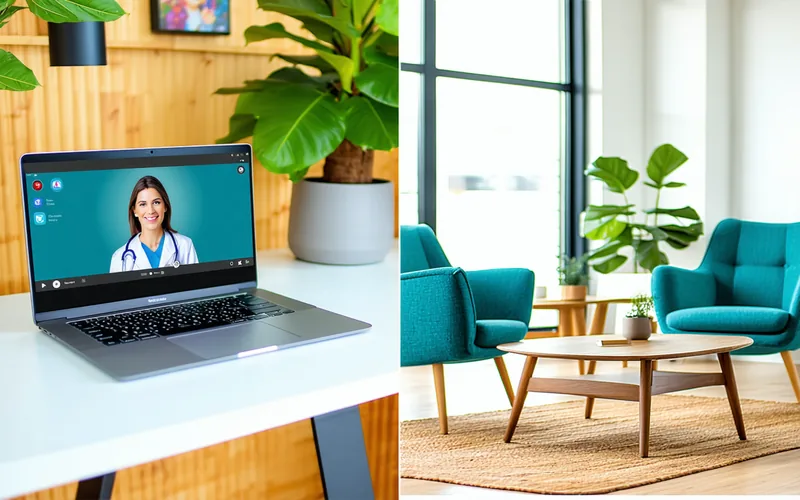
The question "should I see a psychiatrist in person or via telehealth?" gets asked in a number of contexts — sometimes by people brand-new to psychiatric care weighing their options, sometimes by patients already in in-person care wondering whether a switch makes sense, and sometimes by providers trying to advise patients who don't have easy access to in-person psychiatry. There isn't a universal answer, but there are useful clinical principles that can guide the decision.
This article examines the genuine advantages and real limitations of each modality, the clinical situations where each has a clear edge, and the factors that should inform your thinking if you're deciding between the two.
What the research actually says about outcomes
A substantial body of research — including systematic reviews published in journals including JAMA Psychiatry, Psychiatric Services, and World Psychiatry — has examined whether telehealth psychiatry produces outcomes equivalent to in-person care for common outpatient psychiatric conditions. For depression, anxiety disorders, and PTSD, studies have generally found non-inferiority: patients receiving medication management via telehealth show similar outcomes to those receiving equivalent care in person.
The evidence base is strongest for stable, established presentations with ongoing medication management. The evidence is thinner for initial complex diagnostic evaluations, severe presentations, and situations requiring physical examination. This gradient in the evidence should inform how the modalities are used, not whether telehealth is legitimate.
We're not saying the research proves telehealth is identical to in-person care in all situations — we're saying the evidence supports equivalence for the specific clinical situations where telehealth is commonly used, while acknowledging the gaps in evidence for more complex presentations.
Where telehealth psychiatry has a clear advantage
Access and geographic equity. The psychiatric workforce is concentrated in urban areas and wealthier communities. According to data from the Health Resources and Services Administration, a significant proportion of US counties qualify as Mental Health Professional Shortage Areas. For patients in rural Texas, small towns in the Southeast, or any area without a local psychiatric practice, telehealth is not just convenient — it may be the only realistic access option for board-certified psychiatric care without a multi-hour round trip.
Appointment adherence. Patients who begin mental health treatment frequently struggle to maintain it, particularly during the early weeks when they haven't yet seen benefit and the logistical cost of each appointment is felt clearly. The logistics of telehealth — no travel, no parking, no waiting room — reduce the friction cost of attendance significantly. Studies of telehealth mental health care have found improved appointment adherence compared to in-person equivalents, which matters because consistent follow-up is one of the strongest predictors of treatment outcomes.
Specific populations. Patients with social anxiety who find waiting rooms activating. Patients with mobility limitations or physical health conditions that make travel difficult. Parents of young children who can't easily arrange childcare for a 90-minute round-trip appointment. Shift workers with unpredictable schedules. For all of these groups, the format advantage of telehealth is not trivial — it's the difference between getting care and not getting care.
Chronic stable conditions with established relationships. A patient who has been stable on the same medication for two years, sees their psychiatrist for quarterly check-ins, and has a clear sense of their clinical picture doesn't need the full in-person apparatus for every visit. A 20-minute telehealth check-in provides equivalent clinical value for that purpose.
Where in-person psychiatry retains genuine advantages
Complex initial evaluations. A first-episode psychiatric presentation — particularly one involving possible psychosis, cognitive impairment, a complex neurological picture, or significant diagnostic uncertainty — benefits from the full range of clinical observation available in person. Physical examination, neurological screening, coordination with a primary care physician who can do lab work, and the ability to observe the patient in multiple contexts all contribute to a more complete clinical picture. A skilled telehealth clinician can gather a great deal via video, but they cannot do a physical exam, and some diagnostic questions require that.
Severe or unstable presentations. Active mania, moderate-to-severe psychosis, recent psychiatric hospitalization, severe eating disorders, or presentations where safety management requires close clinical monitoring are generally better served by in-person care or, in acute situations, emergency psychiatric services. Telehealth is not a format for psychiatric crisis management — it is a format for outpatient care of relatively stable presentations.
Therapeutic relationship depth in complex cases. For highly complex, long-term psychiatric conditions — treatment-resistant depression, borderline personality disorder, severe trauma histories — some clinicians and some patients find that the therapeutic relationship benefits from in-person contact. This is not a universal finding; many patients with complex presentations do well in telehealth care. But it's worth acknowledging as a consideration for specific situations rather than dismissing it.
DEA Schedule II prescribing. As discussed in our ADHD article: the regulatory landscape for prescribing stimulant medications (Schedule II) via telehealth without prior in-person evaluation remains in flux following the end of the COVID-19 Public Health Emergency. If stimulant medication is likely to be part of your treatment plan, the current regulatory environment may require at least one in-person evaluation before telehealth management can begin, depending on the platform, state, and provider policies.
A practical framework for deciding
Rather than "which is better," a more useful question is "what is the right format for my current clinical situation?" Here is a simplified framework:
Telehealth is likely appropriate if: You have a previously established psychiatric diagnosis you're seeking ongoing management for. You have good insight into your symptoms and a history of medication adherence. Your condition is stable or in a period of mild-to-moderate symptoms. You have logistical barriers to in-person care that meaningfully affect your ability to maintain consistent appointments. You are comfortable with video communication for health discussions.
In-person evaluation may be more appropriate if: This is your first psychiatric evaluation and your presentation is complex or ambiguous. Your symptoms are severe, include psychosis or mania, or have led to hospitalization. You believe physical examination or neurological assessment is relevant to your presentation. You've been recommended by your PCP to see a psychiatrist as part of an evaluation for physical-psychiatric co-management. You've tried telehealth previously and found the format didn't work for you.
A hybrid approach often makes sense: An initial in-person evaluation for diagnostic clarity, followed by ongoing telehealth follow-up once a stable regimen is established, is a rational path for many patients. The two modalities are not mutually exclusive. A relationship with a telehealth provider can be established after an in-person workup; similarly, a telehealth-initiated relationship may at some point benefit from an in-person visit.
Practical considerations beyond the clinical question
Insurance coverage for telehealth psychiatry has expanded significantly since 2020. Medicare covers telehealth psychiatric visits regardless of location following the Consolidated Appropriations Act of 2023, which made permanent many of the COVID-era telehealth expansions for mental health. Most major commercial insurers follow similar policies, though the specific coverage details vary by plan. It's worth confirming telehealth coverage with your insurer before booking either format.
Technology requirements are modest. A stable internet connection and a device with a working camera and microphone are sufficient for most telehealth psychiatry platforms. Smartphone-based visits are technically functional, though a laptop or tablet generally provides a more comfortable experience for longer appointments. HIPAA-compliant video platforms are standard in psychiatric telehealth practice; you should not be asked to use consumer-grade video platforms like standard FaceTime for clinical appointments.
Consider also the question of ongoing provider continuity. One argument sometimes made for in-person care is consistency — seeing the same provider in the same setting builds a stable therapeutic relationship over time. The same logic applies to telehealth: if your telehealth practice has high provider turnover, or if you're being matched with whoever is available rather than a consistent provider, that's a care quality issue independent of the modality. Ask your telehealth practice about provider continuity policies before you commit to care.